Wednesday, February 13, 2013

Wordless Wednesday: Retasting Taste

Romanesco salad with pancetta, walnuts, golden raisins

Sweet potato gnocchi with house-made duck and fennel sausage, pear, winter greens

Grilled prosciutto and mushroom flatbread with shaved Parmesan, mache


Tart Tatin with whisky caramel, fennel anglaise, brown sugar gelato


Saturday, February 9, 2013

Smashed Potatoes

You heard me. Smashed. Because sometimes there's just not time to vent and then make dinner. Sometimes, you need to multitask.


Ingredients
Smallish purple, red, and/or yellow potatoes, brushed clean and punctured with a fork
Salt and freshly ground black pepper
Grated cheddar or pepper jack cheese
Chopped parsley

Boil potatoes until tender (a fork should insert easily). Drain and allow to cool slightly.

Smash each potato lightly with the flat side of a meat tenderizer or a mallet. If others ask what you're doing, say "WHAM!" loudly as you smash the next potato, and they will most likely back away slowly and leave you in peace to finish eloquently articulating how you feel about your day.

Sprinkle lightly with salt and pepper, then liberally with cheese and parsley.


Serve hot, eat hungrily in good company, and decide that your day turned out just fine.

Saturday, January 26, 2013

Butternut Squash and White Bean Soup

Found in the cupboard: Cannellini beans. Found on top of washing machine: 1 butternut squash (don't ask). Found in freezer: Spinach. Solution on a wintry evening while fending off a cold? A hearty, soul-warming soup (adapted from here).


Ingredients
Olive oil
1 large shallot, chopped
1 small butternut squash (2-2.5 pounds), peeled and diced
1 tbsp chopped fresh rosemary
1 bay leaf
3 cups chicken broth
1/2-1 cup frozen spinach
1 can cannellini beans, rinsed and drained
Salt to taste (less if the chicken broth is highly salted)
2-3 pinches Meyer lemon zest
White pepper
A little Pecorino or Parmesan cheese (optional)*

Heat a soup pot over medium heat. Add a glug of olive oil and the shallot, and saute for 2-3 minutes until soft. Add the squash and saute, stirring occasionally, for about 5 minutes. Add the rosemary and bay leaf, and saute for a couple minutes more.

Pour in the chicken broth, stir once, and cover the pot. Bring to a boil, then reduce heat and simmer for 12-20 minutes (depending on how big your cubes are), until the squash is just tender. Add the spinach and the beans, return the soup to a simmer, and cook for about three minutes more.

Add salt and lemon zest to taste (there's enough salt when the broth tastes flavorful, and there's enough lemon zest when you can taste just a hint of it). Ladle into bowls, sprinkle with white pepper, and grate just a very little cheese over the top if desired (like 2-3 passes across a microplane per bowl).

Serves 2-4.


*If you live near the Sacramento Co-op, there is a cheese there called Pecorino Moliterno with Truffles. Buy it, revel in what happens when you eat it alongside a tart apple, think of it obsessively the entire next day, and also use it here.

Saturday, January 12, 2013

Brussels Sprouts with Bacon and Lemon Zest

This will come as a shock to all regular readers, I know, but the truth must out. I used to not like something that I now love. Shockingly-er still, it has something to do with bacon.

 
I'll give you a moment to recover.


The formerly-disparaged vegetable in question this time is the Brussels sprout. I could wax palaverous about my conversion, but I'll spare you this once. The short version is, in the following order:
1. Ugh.
2. Tuli Bistro
3. Oh!
4. The following recipe.
5. Gosh I love Brussels sprouts. Do you want to make Brussels sprouts tonight? I really love Brussels sprouts, don't you? Hello, check-out person at the co-op! Have I talked to you about my deep and profound love of that vegetable you're ringing up there? Hey guy next to my car, guess what? Brussels sprouts! (To which my husband replied: Yes dear. Get in, please.)

I know I say this a lot, but I mean it every time: Make this.

Love the Brussel. Be the Brussel. Eat the Brussel...


Ingredients
1 slice Niman Ranch applewood smoked bacon, sliced crosswise
Olive oil
1/4 red onion, thinly sliced
3/4 lbs small young brussels sprouts, washed well and halved
(for larger sprouts, separate the outer leaves)
1/4 cup chicken broth
1 tsp lemon zest + 1 pinch sugar, mixed
1 oz blue cheese, crumbled or cut into small pieces
(We tried this with a crumbly blue cheese and a creamier/tangier blue cheese and preferred the crumbly one)
Salt to taste

Heat a wide nonstick pan over medium heat. When hot, add the bacon, and saute for a minute. Add a glug of olive oil, the onion, and a pinch of salt, and saute for another couple minutes until the onion softens.

Add the brussels sprouts and a couple liberal pinches of salt, and toss to coat evenly. Saute, stirring occasionally, for about 4 minutes.

Add a splash of broth to create some steam and cover the pan. Continue cooking for another 4-6 minutes, stirring once in the middle, until the brussels sprouts are golden brown and the hearts are al dente.

Uncover, push to the side of the pan, and add the lemon zest-sugar mixure. Let heat through for 5 seconds, then stir to mix well with the sprouts. Sprinkle in the blue cheese, stir, turn off the heat, and serve hot.


Serves 2.

Tuesday, January 1, 2013

Tangerine Mimosas

Happy New Year, everyone! Ring in 2013 with a sweet twist on the classic mimosa (juice 1-2 tangerines into each half-glass of champagne, clink a toast, and sip happily).


Here's to a new year of recipes to come....

Sunday, December 23, 2012

Butternut Squash Polenta with Sage and Gruyere


You say parsnip addiction, I say parsnip penchant.


We could agree to disagree, or you could surrender to reality. The proof is in the polenta. 

Ingredients
Olive oil
1/2 butternut squash, diced (about 1.3 lbs)
1 large parsnip, diced (about 10 oz.)
1 tbsp pastured butter
2 tbsp chopped fresh sage or a little more (older sage is far less potent, so nibble a piece to taste and adjust if necessary)
1 cup coarsely ground cornmeal (polenta)
2 cups veggie or chicken broth
1/2 cup grated Gruyere cheese (about 2 oz.)
2 handfuls baby arugula, chopped (about 2-3 oz.)
Salt and freshly ground white pepper

Heat a wide saute pan over medium heat. When hot, add a glug of olive oil. Add the squash and parsnip and toss to coat lightly in oil. Cook, stirring every 2-3 minutes, until the squash begins to take on some color and the pieces are tender (about 7-12 minutes. If your pieces are larger, you may need to cover the pan after they've browned a bit and use the steam to get them to cook through).


Push the veggie to the side of the pan and melt the butter on the other side. Add the sage, stir once or twice, then toss with the squash and parsnip to coat. Sprinkle with salt and turn off the heat.

Meanwhile, bring 2 cups of broth plus one cup of water to a rolling boil in a pot. While stirring constantly with a wooden spoon, add the polenta in a slow stream. Continue to stir constantly, turning the heat down slightly, for 3-4 minutes or until the polenta thickens to almost (but not quite) the desired consistency—think spreadable but thick. Turn off the heat and stir in the cheese and arugula.

Combine the polenta and the veggies in either pot. Stir, and adjust sage and salt to taste. Serve immediately, with freshly ground white pepper over the top. Garnish with a little chopped arugula if desired.

Serves 2 for dinner.


(Note that polenta doesn't reheat well, so if you end up with leftovers, one idea is to press them into a square tupperware, refrigerate, and then slice the block that forms into cakes that you can fry in a little olive oil the next day.)

Saturday, December 15, 2012

Smashed Pacarsnip

This recipe is what you'd get if you asked Santa for a magical holiday side dish that was all buttery and wonderful on the outside and a secret nutritional powerhouse on the inside. And Santa would say: "You mean, like mashed potatoes except way easier and also more flavorful while eradicating all vestiges of guilt from the post-helping-yourself-to-thirds phase?" And you would say: "Yes. Exactly like that. And I want to eat it while flying through the air on a reindeer."


And then Santa would probably say: "One magical thing at a time, please."

And you would pause, because magical reindeer are awesome, but magical side dishes are pretty awesome too.


Fortunately, now that you have the side dish, there's nothing standing between you and Rudolph, should the opportunity arise.

You want a roughly equal volume of carrots and parsnips for this one, and note that the carrots will cook a little more slowly (so if one is cut a bit smaller than the other, it should be the carrots). Also, I highly recommend saying "pacarsnip" out loud, possibly several times in a row.

Pacarsnip.

Ingredients
Olive oil
4 large carrots, peeled and cut into 1-inch pieces
3 large parsnips, peeled and cut into 1-inch pieces
1/3 cup broth
1 tbsp pastured butter
1 large handful flat-leaf parsley, chopped (3-4 tbsp)
Salt and freshly ground white pepper to taste

Heat a pot (not nonstick) over medium heat. When hot, add a glug of olive oil. Add the veggies and stir to coat lightly. Cook, stirring every 2 minutes or so, for 5-10 minutes until many of the pieces take on some golden caramelized color on at least one side.

Add the broth, cover, and turn the heat down to medium low. Simmer, stirring well every 5 minutes to circulate which veggies are on the bottom, for 15-20 minutes or until veggies are tender enough to mash. (If the pot dries out, you can add a little more broth; if there's excess at the end, drain it or let it evaporate.)

Add the butter as you start mashing the vegetables with a potato masher. After a minute, turn off the heat. Mash until desired consistency, stir in the parsley, and add salt and pepper to taste. Serve hot.

Serves 4.

Tuesday, November 27, 2012

Roasted Vegetable Soup

Every now and then...approximately once a year, to be precise...we manage to roast so many winter root vegetables that we have leftovers.


You might wonder, given how frequently we roast them, that there aren't leftovers more often. I blame parsnips. You see, we'll start out with the best of intentions to stop eating before the bottom of the pan, but then there will be a parsnip, and the only way to get to the parsnip will be to eat the carrot above the turnip above the yam that's covering it. It's entrapment by parsnip. That's totally a thing. Look it up.


In any event, if you should ever find yourself with leftovers (to roast, simply cut your carrots, parsnips, turnips, and/or yams into equal-sized chunks, toss liberally in olive oil and—if you'd like—a couple cloves of pressed garlic and some chopped fresh thyme, then roast at 425°F for about an hour, stirring every 15 minutes, till caramelized and tender)...if this serendipitous and rare occurrence of abundance should ever happen to you, here's what you do:

1. Remove serendipitous leftovers from fridge.

2. Put in a pot.

3. Cover (almost to the top) with good-quality, flavorful veggie broth.

4. Bring to a simmer.

5. Blend with an immersion blender until desired consistency. (If it's too thick, you can add more broth, but note that thicker also means more roasted veggie flavor.)

6. Add a slosh of cream, and adjust salt to taste.

7. Serve warm, garnished with nasturtiums and/or a bit of chopped parsley.


Sunday, November 18, 2012

Plants for Breakfast: Roasted Sweet Potato Rounds


In our ongoing quest to discover easy and delicious mostly-plant breakfasts, we stumbled on this one completely by accident. All you need is a few spare yams next time you're roasting something in the oven, and voila—breakfast and/or afternoon snacks for the rest of the week. (Or at least for the next two days. They're shockingly addictive...kind of like giant sweet potato fries big enough to sink your teeth into and healthy enough to eat by the plate.)


Ingredients
Olive oil
Garnet yams, peeled and sliced into 1/2 inch rounds

Preheat oven to 425°F.

Brush yam slices liberally with olive oil and arrange on a foil-lined baking sheet. Roast for 20 minutes or until golden brown on the bottom, then turn slices and roast for 15 minutes more or until both sides are nicely browned.

Let cool, then refrigerate until you want them. You can reheat them for breakfast or sneak them straight out of the refrigerator when you think no one is watching.

Saturday, November 10, 2012

Fall Fig and Gorgonzola Crostini

Sweet ripe figs and tangy blue cheese make a heavenly pairing for easy and elegant crostini appetizers, or grab a loaf of Village Bakery's walnut levain and make sinfully rich open-faced sandwiches for lunch.

Ripe figs are key here...after you buy them, leave them out of the refrigerator until they feel soft when you squeeze them gently between thumb and forefinger. If you must make this before your figs finish ripening, you could drizzle a little honey over the top to sweeten, but it's worth waiting an extra day for the figs to sweeten themselves.

Ingredients
Small or large slices of bread, toasted
Gorgonzola, Bleu d'Auvergne, or another creamy blue cheese
Ripe figs, halved lengthwise and then sliced into thirds


Spread a thin layer of blue cheese on the toasts, top with figs, and serve.


Saturday, October 27, 2012

Roasted Acorn Squash

Looking for some roasted squash to pair with your braised kale for a cool-weather feast? Look no further.


Ingredients
2 acorn squash, halved lengthwise
Olive oil
1/2 tbsp pastured butter
1 smallish shallot, chopped
1 tbsp fresh chopped sage (or thinly slice crosswise into ribbons)
2 tbsp pine nuts

Preheat the oven to 400°.

Brush cut side of squash with olive oil and turn face-down on a foil-lined baking sheet. Bake for 45-80 minutes or until tender (the back of the squash should yield a little to a gentle poke with a pot-holdered finger).

About 10 minutes before the squash are done, heat a small pan over medium heat. Melt the butter, add a small glug of olive oil, and then add the shallot. Saute for a minute until they soften, then add the pine nuts and the sage and turn the heat down slightly. Continue to cook for another 1-2 minutes, then remove from the heat and set aside.

Turn the squash right-side up and test them for doneness with a fork or spoon in the middle of the cavity (the flesh should be smooth and soft, not hard or grainy). Add a dollop of the pine nut sage mixture to each half and spread across the bottom, then return to the oven and bake another 5-10 minutes until very soft.


Serves 4.

Sunday, October 21, 2012

Braised Kale

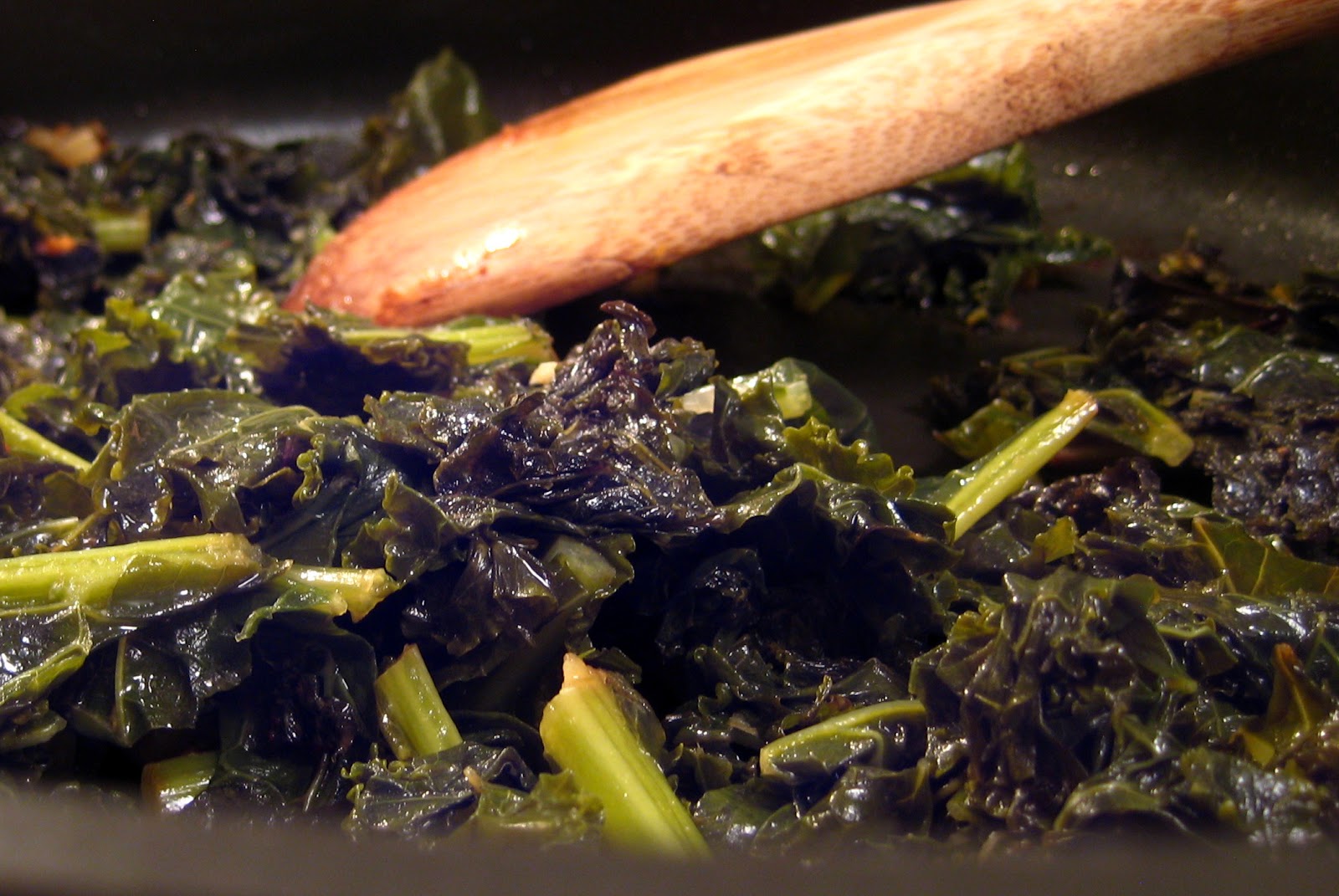
Red Russian kale becomes heavenly when roasted. Green kale, it turns out, is meant to be braised, which turns it from obligatory health food to addictive melt-in-your-mouth caramelization with a southern, collard greeny feel.

Serve this alongside roasted squash and lamb or chicken for a richly delicious fall meal.


Ingredients
Olive oil
2-3 cloves garlic, smashed
1 small to medium shallot, halved lengthwise and sliced
1 bunch green kale, sliced crosswise into ribbons, washed well, and spun dry in a salad spinner
1/4-1/2 cup chicken broth
Salt

Heat a generous glug of olive oil in a wide saute pan over medium heat. Add the garlic and shallot and saute for 1-2 minutes, until they soften slightly. Add the kale, in batches if the pan isn't big enough to hold it all at once before it starts to wilt, and toss well with the garlic and shallot. Saute, turning occasionally with tongs, until the kale wilts down quite a bit and starts to brown slightly here and there, drizzling with a little more olive oil if necessary.

When the kale is browned in a few places, add about half the broth and a pinch of salt. Cover and turn the heat down slightly. Simmer for about 20-30 minutes until the greens are very tender, stirring every 5-10 minutes and adding a little more broth if the pan gets too dry. (If the pan does dry out and you don't catch it in time, never fear: This is the sort of dish that gets better the more times it caramelizes as it sticks to the bottom of the pan.)

When the greens are very tender and deeply delectable, turn off the heat. Adjust salt to taste, and serve hot.

Serves 2-4.

Saturday, October 13, 2012

Dragon Beans with Shallot and Balsamic Reduction

One day in early autumn, while forging through the tulgey wood,* we found dragon beans.
 
Obviously, the name alone meant that we had to buy them. There is, after all, something deeply satisfying about responding to the question "What should we have for dinner tonight?" by yelling "DRAGON BEANS!" at the top of one's lungs. Try it. You'll see.

(Yes, that is your neighbor staring through your kitchen window at you, and yes, he could probably hear you just then as you were gleefully screeching about mythical vegetable beasts, but that wide-eyed look on his face is obviously just jealousy about your dragon beans. He probably wants to steal them. You should no doubt lock the window and then yell DRAGON BEANS again, with emphatic arm movements, just to stake your claim.)

It just so happens that dragon beans are also (a) gorgeous and (b) deeply delicious. They would be lovely kept raw, in a salad, or arranged on a plate as crudité. We cooked ours (after liberal nibbling), which meant that they lost their fancy coloring, but they turned out so sweet and juicy and delectably addictive that we forgot to care.


Ingredients
Olive oil
1 small shallot, halved lengthwise and sliced
2 mild chile peppers, sliced into thin rings
1 lb dragon beans (or sub any especially crunchy, juicy green beans)
About 2 tbsp chicken broth (or sub veggie broth)
About 2 tbsp sweet basil chiffonade 
2 tbsp balsamic vinegar
Salt and freshly ground black pepper
Fresh nasturtium flowers (optional)

Heat a wide saute pan over medium heat. When hot, add a generous glug of olive oil, then add the shallot and chiles and saute for two minutes or so until they soften. Add the beans and toss to coat. Continue cooking for about five minutes, tossing every minute or two.

Add a slosh of broth, cover, and turn the heat down to medium-low. Let steam for 2-3 more minutes until they are a minute away from al dente. (If the beans are especially crunchy and juicy, like ours were, you might want to stop cooking them on the early side to capitalize on that.)

Push the beans to the side of the pan, add just a bit more olive oil and the basil, and fry for 30 seconds. Push to the side with the beans, tilt the pan toward the empty side, and add the balsamic vinegar. Keep the pan tilted with the vinegar side over the flame as it simmers, until it reduces in volume by about half. Turn off the heat, stir to coat evenly, and serve.

Garnish with nasturtiums.

Serves 4.

*a.k.a. our co-op

Tuesday, October 9, 2012

Carrot Cake Pancakes with Toasty Pecans and Ginger-Apple Compote


Here's the thing. Let's say the school year has hit, and you're going up for tenure next year, and your calendar is flooded with back-to-back meetings and classes and meetings, and you're not sure which way is up, and you just woke up on a Sunday morning with the disorienting sense that it might be Tuesday.

Or let's say you've been meaning to bake a carrot cake for your husband's birthday. Since, well, technically since last October.


Or let's say you deeply need a nice big dose of delicious.

Or let's say you have decided to dedicate some portion of your life to pursuing the impossible dream of cooking the Perfect Breakfast—one that tastes sinfully like dessert while also magically possessing the nutritional profile of MyPlate's Platonic ideal of a meal, perfectly balancing whole grains, low-fat protein, fresh vegetables, and fruit—like you're some sort of Willy Wonka-inspired, pancake-obsessed locavore whose brain has been stir-fried by lack of sleep and looming deadlines and the early morning hour and a dazzling array of fresh fall carrots glowing orangely from the depths of the refrigerator.


Or let's say you're none of the above, and just happen to be reading this.

If so, I have important Life Advice.

Are you listening?

Make these.

(Adapted from this recipe with a glance at this recipe and a persistent personal addiction to toasted pecans and gingery apple-based toppings.)

Ingredients
1/2 cup stoneground whole wheat flour
1/2 cup all purpose flour
1 tsp baking powder
1/2 tsp baking soda
1/4 tsp table salt
1/2 tsp ground cinnamon
3/8 tsp freshly grated nutmeg
3 tbsp toasted chopped pecans
(toast whole in a pan until fragrant, shaking from time to time, then chop)
1 egg
2 tbsp packed brown sugar
1 cup buttermilk
1 tsp vanilla
1/2 tsp grated fresh ginger root
2 cups grated carrot (brush well, then grate with the fine hole side of a box grater)

For the compote:
2 apples, peeled and flat-diced (or zanziputted, if you will, which I would and did)
2 tbsp pastured butter
2 tsp packed brown sugar
1/2 tsp grated fresh ginger root
Generous dash or three of cinnamon
Maple syrup for the table

Mix the dry ingredients (flours, baking powder, baking soda, salt, cinnamon, nutmeg, and pecans) together in a large bowl. In a smaller bowl, beat the egg, then mix in the brown sugar, buttermilk, vanilla, and finally the grated ginger. Add the carrots, and mix well.

Gently stir the wet ingredients into the dry ingredients until just blended (I'm always hearing that the secret to fluffy pancakes is to not over-stir, and after careful and strenuous empirical tests involving delicately cramming large bites of pancake into my mouth, I have decided that I agree). Let rest for five minutes.

Meanwhile, prepare the ingredients for the compote. Melt the butter in a pot over medium heat. Add the apples and stir to coat, then cook, stirring occasionally, for a minute or two. Add the brown sugar, ginger, and cinnamon, and cook for a minute or two more, until the apples just start to release a little juice. Cover, turn the heat down to low, and simmer for about five minutes or until the apples are desired tenderness. Turn off the heat.

While the compote is simmering, start the pancakes. Heat a wide nonstick pan over medium heat. Add a small pat of butter and use a nonstick spatula to spread it in a thin layer over the pan. Add pancake batter by the quarter cup (you can also make these silver dollar pancakes as its ancestral recipe apparently recommends, by dropping the batter in 2-tbsp increments instead). Cook for about two minutes until the sides look a little dry and the bottom is golden brown, then flip and cook 2-3 minutes more until both sides are golden brown and the inside is cooked through.*

Stack the accumulating pancakes inside a piece of tin foil loosely folded in half that you set on the burner behind your pan, or put them in the oven set on low to keep warm.

Serve topped with compote and extra toasted pecans if you have them, with maple syrup on the side for drizzling.

Serves 4.**


*It is perfectly acceptable at this point to taste-test a pancake to make sure it's cooked. Just try to save a few for breakfast. If you're making the slightly bigger pancakes, you may want to turn the heat down just a little after the first batch, so they cook through all the way without turning too dark on the second side.

**These also reheat well the next day if you make extra (just stick in the toaster for about half the length of time you'd use for a piece of toast, and apply liberally as a heavenly Monday morning inoculation against the work week).

Saturday, September 29, 2012

Mostly Plants for Breakfast: Pan con Tomate

There is a time for thought and a time for action. And when the evening air turns crisp and cool and the last tomatoes of the season scent the air, one must not pause to think about one's tomato-phobic past, or the sorrow of tomatoless days to come. One must act, and act quickly.


In particular, one must launch oneself tomato-ward at top speed, past any intervening humans, shopping carts, small dogs, and/or cantaloupes, leaping or ducking as needed (depending on the relative heights of all parties involved) until one arrives at the tomato epicenter—then promptly snatch them up, take them home, eat them, and cackle happily.

Here's one of our summertime favorites: pan con tomate. Perfect for an Andalusian breakfast or an evening appetizer or anything in between.

Ingredients
Fresh bread, sliced
Ripe tomatoes (any size)
Fruity olive oil
Salt

Halve cherry tomatoes, or halve and then grate larger ones using the largest side of a box grater, discarding the skin as you go.

Toast the bread, then drizzle with olive oil. Spoon the tomatoes over the top, sprinkle with salt, and serve.

Sunday, September 23, 2012

Now on Facebook!

Cook Food Mostly Plants now has a Facebook page! The page makes it easy to view recent posts, leave comments and ask questions, or share photos or suggestions when you try a new recipe.

Click the "Like" button in the top right corner under the banner to get links to new posts on your News Feed, or just to show your support!

Thursday, September 20, 2012

Corn Soup with Sauteed Huitlacoche

There's no delicate way to phrase this. My husband is obsessed.


It all started innocently enough. In our Co-op, or in a corn field, depending on how far back you want to go. It doesn't really matter. The end result is still the same.


He returns home one day with An Announcement. "You'll never BELIEVE what I saw at the co-op." I perk up. (This was back at the beginning of September, when I was young and naive and innocently hopeful.) I think he's about to name a new exotic fruit that's shaped like a pear and colored like a parrot, or perhaps a six-foot long vegetable that gets roasted whole over a fire pit in certain areas of the Yucatan. "What??" I say, excitedly. He beams at me, or grins fanatically, depending on how you look at it. He leans forward. 

"There's this crazy mushroom that grows on corn."

"Yes," I say.

"Hyoo-it, hyoot, hwit..."

"Huitlacoche?" I say. (I had encountered it once in a phenomenal quesadilla at Toloache
in Times Square, where I'd learned both to pronounce it—weet-la-COH-chey—and not to think too carefully about what it looked like before it was prepared.)

"That," he says. He leans forward a little further.

"WE ARE GOING TO COOK IT," he says.

"Well," I hedge, "It's kinda..."

"WE ARE GOING TO COOK IT."

"It's like corn mold. I don't know if..."

"I'll cook it. We're cooking it. It's amazing."

He turns to his laptop, starts typing. I think maybe it's a reprieve—he's gotten distracted by email. Five minutes later, he looks up, clearly delighted. "It's also called CORN SMUT," he announces happily.

 
I think that was the moment I knew. It was huitlacoche or bust.


To prepare huitlacoche, which you'll be reassured to learn is a delicately corn-flavored, nutrition-packed delicacy, rather than a fearsome fungal predator, peel back the corn husk and silk and gently pry the "kernels" of the mushroom from the cob either by hand or using a table knife for a little leverage. You can either chop them, slice them, or leave them whole, depending on how adventurous you're feeling in terms of texture and taste (we left the smaller ones whole, just to see what they were like, but I think next time I'd try slicing or chopping to keep the texture a little more even). The mushroom (also known as Mexican truffle) should be fairly firm, like corn itself, and a cloudy, faintly bluish-tinged color when you buy it (slimy means it's over the hill). And despite my initial skepticism, this truly was delicious.

Ingredients
Olive oil
1 tbsp butter
1 small yellow onion, chopped
2 cloves garlic, 1 pressed and 1 smashed
3 ears fresh corn, kernels sliced from the cob
Chicken and/or veggie broth (about a cup)
Pinch ground cumin
Salt and freshly ground black pepper
1-2 tbsp cream
1 tbsp chopped Anaheim chile
2 tbsp huitlacoche
1 tsp chopped fresh cilantro, plus extra leaves for garnish 

Heat a pot over medium heat. When hot, add half the butter and a glug of olive oil. Add the onion and a pinch of salt, and saute until soft. Stir in the pressed garlic clove and saute a minute more, then add the corn. Cook, stirring occasionally, for another couple of minutes, then pour in enough broth to just cover the kernels. Bring to a gentle boil, turn the heat down to medium low, and cover. Simmer 5-10 minutes, until the corn kernels taste tender and fully cooked.

Meanwhile, heat the rest of the butter and a glug of olive oil in a small pan over medium heat. Add the smashed garlic and the Anaheim pepper, and saute for a minute or so until they soften, pressing the garlic into the olive oil to flavor. Add the huitlacoche and a pinch of salt, and saute for about two minutes. Turn off the heat, remove the garlic clove, and sprinkle in the cilantro.

When the soup is done, puree with an immersion blender until smooth or desired consistency. Add a dash of cumin, a slosh of cream, and season with salt and pepper to taste.

Ladle soup into bowls. Place a dollop of the huitlacoche in the center, drizzle the soup with a little of the extra oil from the pan, and garnish with cilantro leaves. Serve hot.


Serves 2-3.