Saturday, May 21, 2011

Nopalitos with Cilantro

Found in our produce box: Spineless nopales. Which seem on par with seedless watermelons, as culinary inventions go. Now if someone would only develop stingless nettles....

Ingredients
2-3 medium (6" or so) Luther Burbank Spineless nopales (cactus pads)
Small handful cilantro, chopped
Olive oil
Black pepper

Slice the bottom off each cactus pad, then cut crosswise into 1 inch sections. Turn 90 degrees and slice each section lengthwise (or what would have been lengthwise when the pad was whole).

Toss in a bowl with olive oil, cilantro, and a little freshly ground black pepper to taste.

Serve as a side salad or relish with tacos, or layer over rice and beans (here, we sauteed some chopped spring onion, Aleppo pepper, and green garlic, added a can of black beans, and simmered for 5-10 minutes before serving over red rice and sprinkling with a little pepper jack).

Serves 2-4.

Saturday, May 14, 2011

Mostly Plants in a Hurry: Egg Sandwich with Leafy Greens

The basic idea here is to take something oniony, something green, and a bit of a fresh herb and let them play nicely in a pan together with a couple of eggs. Dinner in ten minutes, but all leafy and fresh and flavorful. (Unlike the TV dinners that I catch myself missing once every few months when I'm mournfully wandering about our whole-foodified kitchen late at night looking for something quick and easy to make.)

Ingredients, per sandwich
Olive oil
1-2 shallots, quartered lengthwise and sliced
1 cup frozen organic cut leaf spinach
1 cup sliced mystery greens from your CSA box
Couple pinches fresh chopped oregano
2 pastured eggs
Salt and freshly ground black pepper
Ñora pepper
2 slices multigrain, not-too-many ingredient bread, toasted*

Heat a glug of olive oil in a nonstick pan over medium heat. When hot, add the shallot and a pinch of salt and saute until lightly golden. Add the frozen spinach and continue to cook, stirring, until it thaws in the pan, then add the fresh leafy greens and saute until tender (a minute or two for baby greens; longer for something like chard or big mustard greens which might need to be covered for a bit of quick steaming to cook through).**

Add the oregano, stir a couple times, then turn the heat down to medium low. Crack the eggs into the pan, let sit for 10-20 seconds, and then slowly stir into the greens, breaking first one yolk, waiting a moment, then breaking the other. Sprinkle with a pinch more salt, some black pepper, and a bit of ñora pepper if you have it. Stir or flip the eggs a few times until cooked through, then turn off the heat.

Drizzle each piece of toast very lightly with olive oil, and serve with the eggs sandwiched in between.


*Finding good sandwich bread without a mile long, super-processed ingredient list can be surprisingly difficult. If you live in the Sacramento area, our current favorite is Grateful Bread Company's Woodstock bread (available at places like Taylor's and the Co-op). Or, head to your local bakery and pick up something fresh.

**Note that the secret to this recipe is all in getting enough flavor from the shallot and the greens. If you use a yellow onion instead of shallot, use about half an onion per sandwich, slice into half or quarter rings, and make sure you give it time to lightly brown in the pan before adding anything else (onions release more liquid than shallots, too, so you might wait on the pinch of salt until they've already browned). And make sure there's more greens than eggs...it seems like adding more egg would make it richer, but it's actually much more flavorful with lots of greens and only one egg than it is with mostly egg and a little green.

Sunday, May 8, 2011

Fresh Fava Beans

Necessity, they say, is the mother of invention. And when fresh favas show up in your CSA box for the fourth week in a row, any patient fondness you had for the quaint pastime of shelling broad beans tends to give way to a sudden need to drastically reduce the proportion of your life spent wrestling them out of their pods as compared to, say, sleeping.


So here, then, are the shelling shortcuts that turned two big bags full of favas into one smallish bowl full of beans in about half the time that it would have taken me a few days ago. I suspect these have already been discovered by many fava aficionados, but here they are in detail for the rest of us.

Shortcut #1: Speedy Shelling

Step 1: Set yourself up with a pile of unshelled beans on one side of you and a big colander or bowl on the other. I found it easier to stand with the bowl below me (so that I could angle the beans down into the bowl more easily).

Step 2: Take a pod and hold it horizontally in front of you. With your right hand (if you're right-handed), pinch the first bean (within the pod) from the right between thumb and forefinger.
 

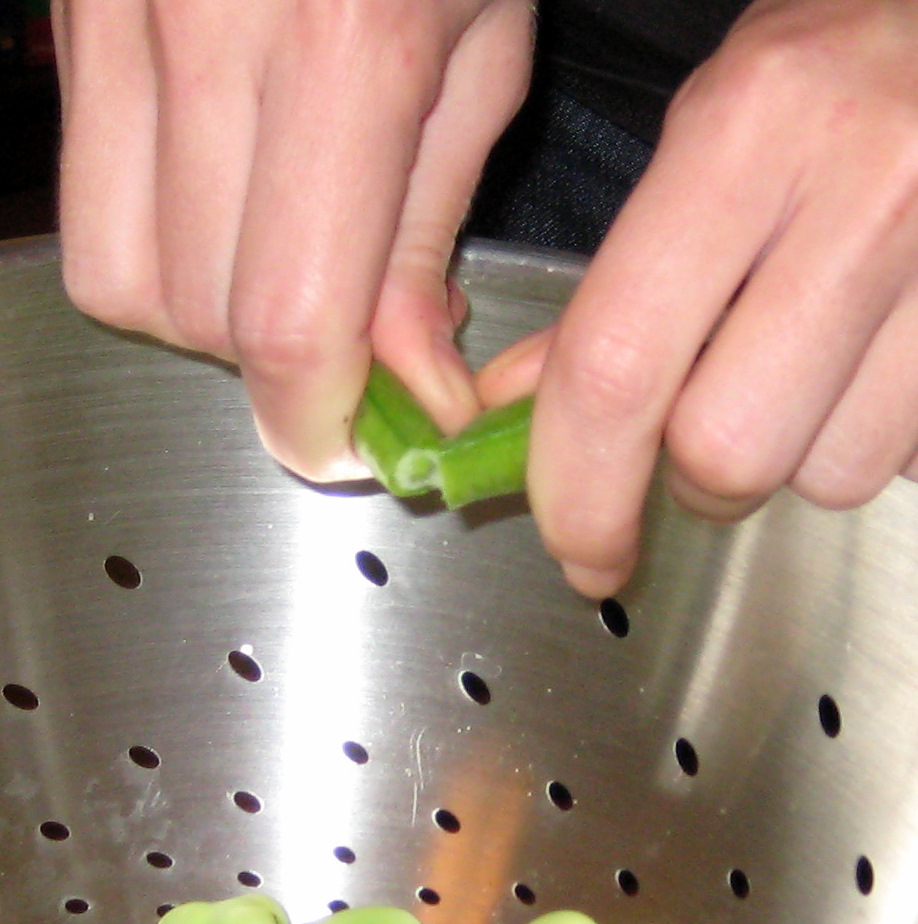
Step 3: Push the bean forward with the flat of your thumb, bending the pod until it breaks open. Try to place your thumb about a third of the way down the bean, and push diagonally (forward and to the left). You want to break the pod so that a little bit of bean is already sticking out (rather than breaking it right in the middle of two beans, in which case both will be stuck inside the pod).


Step 4: Keep pushing with your thumb, and pinch the pod to squeeze the bean forward and to the left, out of the pod and into the bowl. (Warning: once you get good at this, the beans start shooting out very quickly, so aim down into the bowl if you don't want beans zinging around your kitchen.)

Step 5: Move down the pod to the next bean, and repeat.

Play around with where exactly you're pushing on each individual bean until you find a sweet spot that allows you to break the pod and push the bean out in a single quick motion. When you find it, you'll be able to do the whole pod in just a couple seconds.


Shortcut #2: Faster Peeling

Step 1: Bring a pot of water to a rapid boil. Drop your shelled but still unpeeled favas in and blanch for 2 minutes or until the skins just start to turn white. Drain and run under cold water until the beans are about room temperature.

Step 2: Take each fava bean and break open the bottom of the bean (the fat end, where the skin is thickest). With your other hand, gently pinch the skin on the unbroken side, to squeeze the inner bean out through the opening you just created.


Saute your favas with olive oil, pancetta, and slivered garlic, or combine with other fresh and mild ingredients for a simple pasta or risotto. Favas remind me of fresh peas -- they seem to work best in dishes that are simple enough to complement their fresh, springy flavor without overpowering it.

Friday, May 6, 2011

Quinoa with Fresh Favas and Crispy Kale

We've been getting fresh fava beans in our CSA box. I'm still not sure if they're amazingly delicious, or if you just end up thinking they're amazingly delicious to justify all the effort that goes into preparing them. But either way, I suppose, you end up enjoying your dinner. This recipe only calls for a few, so it doesn't actually take too long, and although I think that perhaps you're supposed to do some complicated blanching thing with favas after getting them out of their outer pods, I am impatient and just used my fingernail to peel off their outer skin and it seemed to work fine. 

Ingredients
1/2 cup white quinoa
1/2 cup red quinoa
1 cup veggie or chicken broth
1-2 shallots, quartered lengthwise and sliced
3 stalks green garlic (bottom half only), sliced crosswise
One or two handfuls of fresh fava beans, shelled
Salt
1/2 bunch dino kale, sliced crosswise into strips


Rinse the quinoa well in a sieve, then set in a bowl of room-temperature water and let soak for 10-20 minutes. Rinse once more, and drain well.

Preheat the oven to 375.

Heat a little olive oil in a pot over medium heat. When hot, add the shallot, green garlic, and a pinch of salt, and saute for a 2-3 minutes until soft.

Add the quinoa and cook for another minute, stirring, then add the broth and just barely under 1/2 cup of water. Cover, bring to a boil, then reduce heat to let simmer 10 minutes.


Add the fava beans, stir once, replace the cover, and simmer for another ten minutes.

Meanwhile, toss the kale with a little olive oil, spread on a baking sheet, and roast in the oven for 6-10 minutes until crispy, stirring once.

Fluff the quinoa, and serve with small crispy pieces of roasted kale over the top.

Serves 2-3 as a side dish.

Sunday, May 1, 2011

Pappardelle with Mushrooms and Radicchio

I think that sometime in the last few months I may have suggested, somewhere between one and fifty-six times, that there is nothing better than homemade pasta. Correction: There is nothing better than getting home late on a weeknight, wondering what to have for dinner, and taking out the extra pasta you made last weekend for a quick and easy, throw-it-together dinner that tastes like you must have secret Italian house elves working away in your kitchen at all hours. So here is what you should do: Make a double-batch of this recipe on a lazy Sunday afternoon. Cut half the sheets of dough into pappardelle noodles and make the recipe below, but let the other sheets dry for a couple hours (so they're not sticky anymore) before running them through your fettuccine attachment. Carefully lay the noodles in wax paper in a wide tupperware, cover tightly, and stick them in your fridge. Later in the week, you can just drop them in a pot of salted boiling water for two minutes and toss them with some olive oil, garlic, sauteed greens, black pepper, and parmesan.

On Sunday, meanwhile, you have this:

Ingredients
2 servings homemade multigrain pappardelle
2 strips Niman Ranch applewood smoked bacon (or sub pancetta), sliced crosswise into strips
Olive oil
1-2 shallots, quartered and sliced
1 clove garlic, halved and slivered
2 cloves garlic, pressed
1/2 spoonful Aleppo pepper
3 small heads radicchio, bottoms cut off, sliced crosswise into ribbons, rinsed carefully and dried in a salad spinner (about 3 cups)
2-3 sloshes chicken broth
Scant 1/2 lb crimini mushrooms, sliced
Scant 1/2 lb shiitake mushrooms, sliced
Salt and ground black pepper 
Slosh of the red wine you're having with dinner
Small handful flat leaf parsley, finely chopped
1/2 cup grated Parmesan cheese

Bring a large pot of salted water to a rolling boil for the pasta.

Heat a wide saute pan over medium high heat. When hot, add the bacon and cook, stirring, until it begins to brown very lightly. Push to the side of the pan, turn the heat down to medium, and add the shallot and slivered garlic to the other side of the pan. Saute, stirring, until soft, turning the bacon once or twice as well. Mix together, add the pressed garlic and a pinch of salt, and saute for another 30 seconds or so.

Add the radicchio and saute, stirring, for a couple of minutes, then add a couple sloshes of broth, cover, and turn heat down to low. Simmer for five minutes. Uncover, adjust the heat up to medium, and boil off any excess liquid.

Add the mushrooms and drizzle lightly with olive oil, and saute, sprinkling with salt and pepper, for 2-3 minutes. Add a generous slosh of red wine and another slosh of chicken broth, turn the heat down to medium-low, and simmer until liquid is reduced by half, stirring occasionally.

Add the pasta to the pot of boiling water and cook for a few seconds less than two minutes or until al dente.

Meanwhile, add half the parsley and a bit of the parmesan to the sauce, stir once, and turn off the heat.

Drain the pasta, add to the sauce, toss, and serve. Top with grated Parmesan and parsley.

Serves 2-3.

Thursday, April 28, 2011

Plants for Breakfast: Prosciutto-Wrapped Pears

Who says whole food breakfasts can't be quick and easy?

Ingredients
2 ripe D'Anjou pears, wedged
(they're ripe when they yield easily to a firm press)
3-4 slices prosciutto, cut into strips

Wrap a strip of prosciutto around some or all of the pear wedges. Pop in mouth. Or, if feeling generous and patient, arrange on a plate to share.*

Serves 2-3 for breakfast, a light appetizer, or dessert.

*Sharing can also be useful if someone else is holding your morning coffee hostage until you reciprocate with edibles.

Sunday, April 24, 2011

Spring Salad with Beet and Black Radish

Last weekend, my culinary experiences were forcibly broadened when a black radish was foisted upon me by my very own mother.

I had, until that moment, considered my mother to be a rather mild-mannered and gentle purveyor of food-related provisions, offering the occasional overabundance of Meyer lemons or pears or sweet potatoes to take back with us to Sacramento, or a spare pair of turnips leftover from their CSA box. Such gifts were suggested casually, and could be accepted or declined with no particular emotional consequence.

Not so with the black radish (or radishes, to be precise), which were prepackaged and waiting on the dining room table when I walked in the door of my parents' house last Saturday. The radishes were offered to me with a period at the end of the sentence, rather than a question mark, that stated an incontrovertible transition of ownership rather than a query about the radishes' future abode.
I was taking them with me.

I asked (I had not fully grasped, at this point, the severity of the situation) whether this black radish was the same kind of black radish I had heard certain negative things about several weeks before (namely "usually I love our CSA box, but eughgrh, that black radish...I don't know why anyone would plant those").

It was the same black radish. More alarmingly, I became aware that this revelation in no way changed the fact that I was taking the black radishes with me, and that this fact was as immune to future argumentation as my failed attempts as a child to acquire a kitten or (as I recall, my second choice) a baby sister. My mom looked at me. I could tell she felt a touch of compassion -- after all, she too had once owned a black radish. She tried to look encouraging, in an I-hope-you-don't-suffer-too-greatly-while-eating-your-black-radish kind of way. "Anyway," she said. "You're always taking new ingredients and figuring out recipes for them on your blog. So consider this a new ingredient."

In other words, I was issued a Black Radish Challenge. Here are the results. The bite of the radish offset the sweetness of the beets, and made for a perfect springtime lunch. Thanks, mom. :)

Ingredients
Several big handfuls of mixed baby greens
1 medium beet, peeled and grated
1 black radish, halved, thinly sliced, then cut crosswise into matchsticks (about 1/2 cup, or sub red radishes)
6 quail eggs, boiled for just under 3 minutes, peeled, and halved (or sub 1-2 hardboiled chicken eggs)

Vinaigrette: 
A couple generous glugs of olive oil
1 smallish spoonful grainy mustard
2 spoonfuls sherry vinegar
1/4 tsp minced fresh rosemary
Salt & freshly ground black pepper

Whisk the olive oil, mustard, and vinegar together in a large bowl to form an emulsion (it should be thick but not sludgy -- adjust the amount of olive oil as needed). Stir in the rosemary, salt, and pepper. Next, fold in the beets and toss to coat evenly, then add in the salad greens and toss until the beets are evenly distributed and the greens are lightly coated with vinaigrette. Taste and adjust seasonings as needed (there should be just a hint of rosemary, without it being overpowering).

Arrange the greens on plates, sprinkle with radish, and top with the egg and a bit of extra black pepper.

Serves 2 for a light lunch or side salad.

Saturday, April 23, 2011

Sauteed Turnips and Carrots

Turnips again. But so very good that they deserve their own post, even though this is similar to at least two other recipes already on here. So in case you have these ingredients on hand and need something quicker than roasting, the combination of sauteing and then steaming works beautifully, allowing the veggies to caramelize and cook through in just a few minutes.

Plus, this is the sort of dish that gets even better if you accidentally forget about it for a couple of minutes and almost burn the bottom. Which is basically my favorite sort of dish (the "of course I meant to do that" kind).

Ingredients
1 stalk green garlic, chopped (or sub 1 clove garlic, pressed)
3-4 yellow turnips, peeled, halved (or quartered if large) and sliced about 1/8" thick
4-5 red carrots, scrubbed and sliced
Olive oil
Salt
Freshly ground white pepper
1 tbsp chopped flat leaf parsley

Heat a glug of olive oil in a saute pan over medium heat. Add the turnip and carrot slices, and toss to coat with oil. Continue sauteing for a minute or two, then add the green garlic and stir. Cover the pan and allow to steam as it browns on the bottoms (about 2-3 minutes). Stir, cover, and repeat. The vegetables should release some juices that allow them to steam, but if and when they start to look a little dry, add a pinch or two of salt to coax some liquid out.


Add a tbsp or two of water, cover, turn heat to low, and steam until nicely browned and very tender. Toss with white pepper and parsley to taste, and serve hot.

Serves 2.

Sunday, April 17, 2011

Roasted Kale with Balsamic Reduction

Warning: If you're already addicted to this recipe, this variation is not going to help, although it does allow you to preserve an illusion of variety in your cooking while secretly fulfilling your deep-seated roasted kale obsession.


If you have no idea what I'm talking about, then clearly you haven't had roasted kale before.

This also works well with baby kale, which you might come across at a farmers' market or in your CSA box -- simply adjust the cooking times down a little bit if the leaves are very small.

Ingredients
1 bunch Red Russian or German flat kale (or any sweeter variety)
Olive oil
Salt
Balsamic vinegar

Preheat oven to 400 degrees. Slice kale crosswise into wide strips, then rinse very thoroughly to remove any grit and dry in a salad spinner. Toss kale with olive oil and spread out on a baking sheet a couple layers deep. Roast for 6-8 minutes, depending on the size of the pieces and how many layers you have on your baking sheet, until the edges of the leaves are lightly toasted on the bottom. Turn the leaves over with tongs, and continue cooking another 3-5 minutes until edges start to crisp.

Meanwhile, heat 2-3 tbsp balsamic vinegar in a small pot over medium-low heat. Simmer gently, adjusting heat as necessary, until volume is reduced by half (and try not to breathe deeply right over the pot...evaporating vinegar is not fun to inhale).

Sprinkle the kale lightly with salt, drizzle with balsamic reduction, and serve.

Thursday, April 14, 2011

Roasted Squash and Fava Green Risotto with Lemon

This was kind of like having pumpkin pie and lemon bars for dinner. The Sibley Squash from our CSA box this week was particularly amazing, but I think the recipe would still be very good with a plain old butternut squash instead. After halving lengthwise and scraping out the seeds, slice the squash crosswise into 1/2" slices, then toss with a little olive oil and roast in the oven at 400 degrees, turning every 15 minutes or so, until browned and tender (about 45 minutes -- sometimes I start with the slices still pushed together in the shape of a halved squash for the first 15 minutes, to keep them from drying out too much, and then spread them out for faster cooking). Let cool for a few minutes, slice the skin off, and dice. If there's extra, you can serve the risotto over the slices.

Ingredients 
2-3 cups diced roasted squash (heirloom or butternut)
4 cups broth (chicken and/or vegetable)
Olive oil
1 yellow onion, chopped
1 medium shallot, sliced
2 cloves garlic, pressed
1 generously rounded cup Arborio rice
White cooking wine
Four big handfuls of fava greens (or sub spinach and/or baby arugula)
Large handful flat leaf parsley, chopped
1/2 cup grated Parmesan
Zest of 1 lemon
Salt and freshly ground black pepper

Heat broth in a covered pot until it boils, then set aside.

Meanwhile, heat a large pot over medium heat. When hot, add a generous glug of olive oil. Add the onion and saute, stirring, until it begins to soften. Add the shallot, stir a few times, then add the garlic. Continue cooking for another 2-3 minutes until soft and fragrant.

Add the rice, and stir to coat the grains. Toast, stirring, for about 2 more minutes, then add 1-2 ladlefuls of wine. Cook, stirring, until liquid is absorbed, then begin adding broth by the ladleful, stirring until each one is absorbed before adding the next.

When you have a couple of ladlefuls of broth left and rice is just tender, stir in the squash. Add another ladleful of broth, and stir. When is has been absorbed, add the fava greens and the remaining broth. Cook, stirring, until the greens are wilted. Stir in some of the lemon zest and parsley, cook for a minute more, then turn off the heat. Add the parmesan, then salt, pepper, and additional lemon zest and parsley to taste.

Spoon into bowls, then allow to cool a minute and sprinkle with a little extra parsley before serving.

Serves 3.

Sunday, April 10, 2011

Plants for Dessert: Strawberry Kumquat Salad

I can't quite get over how good kumquats are. I think last time I tried them I was under the impression that you had to peel them before eating, which meant a lot of work for a very sour bit of fruit. The skin provides a zesty sweetness to complement the sour when you pop them into your mouth whole and unpeeled...but in case you're not a fan of the burst of tartness in the midst of the sweet, here's a way to enjoy kumquats that balances out the sour with strawberries and limoncello.

Ingredients
Fresh, fragrant strawberries, sliced crosswise
Kumquats, thinly sliced crosswise (about 1 kumquat for every 3 strawberries)
Limoncello

Lightly drizzle the strawberry and kumquat slices with a bit of limoncello (about half a shot per small bowl of fruit salad) and toss to combine. Serve immediately, or let marinate in the fridge for 10-15 minutes first.

Friday, April 8, 2011

Black Beans and Rice with Cilantro and Lime

I'm not sure it's possible to go wrong with rice and beans, but this version turned out to be particularly addictive. I suspect adding some avocado on top would do delightful things, as well.

Ingredients
Olive oil
1 medium shallot, chopped
1 1/2 cups black forbidden rice (or sub brown and adjust water and cooking time)
1 medium yellow onion, chopped
3 cloves garlic, pressed
1 red bell pepper, chopped
Spoonful Aleppo pepper (or sub a hot pepper, minced)
2 cans black beans, drained just slightly (or sub home-cooked beans and some of their cooking liquid)
1-2 tbsp chopped fresh cilantro
1/2 cup grated extra sharp white cheddar
Salt & black pepper to taste
Lime wedges for garnish

Heat a glug of olive oil in a smallish pot over medium heat. Add the shallot and saute for 2-3 minutes until soft, then add the black rice and saute for a minute more. Stir in 1 3/4 cups water, bring to a boil, then turn heat down and simmer for 20 minutes.

Meanwhile, heat another glug of olive oil in a larger pot over medium heat. Add the onion and saute until translucent, then add the garlic, peppers, and a pinch of salt and continue to cook, stirring, for 2-3 minutes more. Stir in the black beans with their cooking liquid, bring to a simmer, and turn the heat down to medium-low. Simmer for about 10 minutes, with lid either on or off to evaporate some of the liquid, depending on how much cooking liquid is in the pot (you want just enough at the beginning so that the beans can simmer in it, and to have some left at the end without it being very soupy).

Add the cilantro, simmer another minute, then turn off the heat. Adjust cilantro, salt, and pepper to taste. (This is a dish that will do fine if you have to let it sit for a little while before serving -- in fact, it will allow the flavors to blend even more).

Serve the beans layered over the rice, sprinkled with just a little cheese and garnished with a wedge of lime.

Serves 3-4, and does well reheated the next day for lunch.

Tuesday, April 5, 2011

Pan-Fried Turnips

For some bizarre reason, I used to not particularly like turnips. Now I seem to be addicted. I blame this recipe, and others like it that involve browning the turnips with garlic somewhere nearby.  

Ingredients
2-4 turnips, peeled, halved if large, and sliced into 1/4" pieces
Olive oil
1 large clove garlic, smashed
Splash chicken broth
Salt and freshly ground white pepper
Balsamic vinegar (optional)

Heat a glug of olive oil in a wide pan over medium heat. When hot, add the garlic clove and simmer until lightly golden on both sides. Next, add the turnip slices, spreading them so they're a single layer against the pan. Cook for 1-2 minutes, then turn and again spread out. Sprinkle with a very small pinch of salt, cover, and continue to cook for 3-4 minutes, turning halfway through, until at least one side is golden brown.

Add a splash or two of chicken broth and cover the pan again. Turn the heat down to medium-low and let steam for another 4-5 minutes until tender.

Meanwhile, heat 2 tbsp balsamic vinegar in a small pot over medium heat until it simmers. Turn heat down and simmer gently until the volume is reduced by half, then remove from heat. Try not to take a big deep breath over the pot as you do this (i.e., turn on your exhaust fan if you have one).

When the turnips are golden and tender, sprinkle with a little more salt and some white pepper, and serve drizzled with a little balsamic reduction if desired.


Serves 2.

Saturday, April 2, 2011

Orzo with Chickpeas and Broccoli

This recipe involves...are you sitting down? It involves white, processed, supermarket variety pasta. You can go ahead and kick me out of the whole food club now.

The thing is, we have these small, random pockets of processed in our cupboards still, from before our kitchen's whole food makeover. And sometimes, when you're teaching two two-hour lectures back to back and wading through hours upon hours of meetings, you just want something easy to make for dinner. Besides, there are chickpeas in this. And green stuff. So it's really quite decent, in the grand scheme of things, and totally delicious.

You could make this with whole wheat orzo, and adjust the liquid and cooking times accordingly, and feel up to 11% less skeptical about the foodiness of its contents.

Ingredients
Olive oil
1 medium to large shallot, quartered lengthwise and sliced
2 garlic cloves, smashed
1 scant cup orzo pasta
1 1/2 cups chicken broth
1 bunch broccolini or broccoli, sliced at an angle
1 can chickpeas, drained and rinsed
Salt and freshly ground black pepper
Handful flat leaf parsley, chopped
Liberal sprinkling of Parmesan cheese
Lemon wedges (optional)

Heat a glug of olive oil in a pot over medium heat. When hot, add the shallot and one of the garlic cloves, and saute for a few minutes until the shallot is soft and the garlic is lightly browned. Add the orzo and stir to coat evenly. After about a minute, add the broth, cover, and bring to a boil. Turn heat down to low and cook 9-10 minutes, or according to package directions.

Meanwhile, heat a wide saute pan over medium heat. Add a generous glug of olive oil and the other clove of garlic, and simmer in the oil until both sides are golden. Add the broccoli and saute, stirring, for a couple of minutes, then add the chickpeas and saute for a moment more. Add the salt and pepper, and cover the pan, turning the heat down slightly. Steam for a couple minutes until the broccoli is just tender, then add the parsley.

When the orzo is al dente, add the broccoli mixture. Stir, add a splash more broth if needed, and cook for a minute more. Turn off the heat, stir in the cheese, and serve hot, garnished with a lemon wedge if desired.

Serves 2.

Wednesday, March 30, 2011

Arugula Rapini with Garlic and Mustard Seeds

I suspect this would work with any green mystery vegetable. Certainly broccolini would go well (but note that it will probably take a few more minutes to cook until tender).

If you do find yourself with a bunch of arugula rapini, do this with it. Because it is somehow kind of like french fries, only better.

Ingredients
Olive oil
1 large clove garlic, smashed
Yellow mustard seeds
1 bunch arugula rapini
1/4 cup chicken broth (or sub vegetable broth)
Salt and freshly ground black pepper to taste

Heat a generous glug of olive oil in a wide pan over medium heat. Add the garlic and let simmer in the olive oil for a minute or two, then add a scattering of mustard seeds (a couple four-fingered pinches should do it). Continue cooking for another couple of minutes, turning the garlic when it starts to brown lightly on one side.

Add the rapini to the pan. Using tongs, toss with the olive oil and mustard seeds to coat evenly. Cover the pan and cook for 1-2 minutes, then add the chicken broth and salt, cover again, and let simmer 2-4 minutes until tender.

Uncover, let any excess liquid simmer off, and sprinkle liberally with pepper before serving.

Saturday, March 26, 2011

Roasted Butternut Squash Risotto with Smoked Bacon and Arugula

This looks long and complicated, but it's not particularly difficult -- just roast the squash and sweet potatoes at some point during the day when it's easy to check on the oven a couple of times, and set aside until you're ready to cook the risotto. And yes, we've put cumin and bacon in the same dish. You can blame Andalusia (and then, once you've tried it, you can thank the Christians and Moors for generously blending their cuisines as they fought over Cordoba, thereby freeing us of the limiting notion that Moroccan spices don't belong in close company with European herbs and meats).


Ingredients
1 small butternut squash (about 1.5 lbs), halved lengthwise and cut into 1-inch slices
1 thin Japanese sweet potato, lightly scrubbed clean
28 oz veggie broth (Imagine's low sodium is currently our favorite brand)
1 1/2 strips Niman Ranch applewood smoked bacon, sliced crosswise
Olive oil
1 large yellow onion, chopped
1 large clove garlic, pressed
1 generously rounded cup Arborio rice
1/2 tsp ground cumin
1/2 cup dry white wine
Scant 1/2 tsp dried sage
Salt, to taste (unless you're using a heavily salted broth in the first place)
Freshly ground white pepper
4 oz baby arugula
1/2 cup grated Parmigiano Reggiano

Preheat oven to 425 degrees.

Line a baking sheet with foil and sprinkle with a little olive oil. Place squash slices cut side down, still pushed together (so that you have two rows of squash slices that look like the two halves of the squash, face down). Put the Japanese sweet potato on the side of the pan, then roast for 35-45 minutes until squash is golden brown and tender and sweet potato is soft, turning the squash slices on their side about halfway through (to brown on two sides rather than just one). If the Japanese sweet potato is thick, it will take longer to cook than the squash.

Set squash and half the sweet potato aside to cool, then cut away from skin and slice into flattish squares (about 3/4" square and less than 1/4" thick -- you'll want to use all of the squash and enough sweet potato to make about 1/4 to 1/3 cup after it's sliced).

Put the broth in a pot and bring to a boil, then turn heat down to low, uncover, and let simmer gently as you cook the risotto (this evaporates some of the liquid and makes the taste even richer).

Meanwhile, heat a large pot or dutch oven over medium heat. Add the bacon and cook, stirring, until lightly browned. Drain most but not all of the excess fat from the pot, then add the onion and a glug of olive oil and cook for five minutes or so until soft. Next, add the garlic, and continue to saute for a couple more minutes.

Add the rice and cumin to the pot and toast, stirring, for 2-3 more minutes. Next, add the white wine and cook, stirring, until it's absorbed. Begin adding the broth, one ladleful at a time, cooking and stirring until each addition is absorbed before adding the next.

When most of the broth has been added and the rice tastes almost done (mostly soft with just a little hint of crunch in the middle of the grain), add the squash and the sweet potato and stir gently to combine with the rice. Add another ladleful of broth, stir gently, and cook until it's absorbed.

Add the sage, salt, and a liberal dousing of white pepper, and stir to combine. Next, add the arugula and spoon one last ladleful of broth over the top to help it start to wilt. Fold gently into the rice and continue cooking until liquid is mostly absorbed.

Turn off the heat, stir in the Parmesan, and serve. Let cool for a minute or two, then bring to the table.

Serves 3.

Sunday, March 20, 2011

Plants for Breakfast: Japanese Sweet Potato

As a longtime cereal-and-toast person, the first meal of the day continues to be the one I'm most likely to cheat on when it comes to the eating whole foods. It's certainly possible to buy whole grain, not-too-many ingredient cereal or bread, but at the end of the day...or at the beginning, rather...most of the ones that taste good have at least one ingredient in their still rather long list that seems questionable from a Pollanesque perspective.
And while I love making more leisurely whole food breakfasts on the occasional lazy weekend morning, I'm usually too rushed to cook something (and probably too sleep-deprived to be trusted anywhere near an open flame).

Enter the Japanese sweet potato. Because here is all you have to do, it turns out, for a warmly delectable whole food breakfast: scrub a few Japanese sweet potatoes clean, dry them, wrap them in foil, and stick them in the oven along with something else you happen to be baking at a reasonable temperature (anywhere from 350-425 should be fine). Cook until soft (when you poke it with your finger, it should give easily), then remove from oven and let cool. Drain if necessary (sometimes a little liquid collects in the foil), and stick in the fridge.

For breakfast, take a half or a whole potato, slice lengthwise, and warm in the microwave for a minute or two until hot. Sprinkle with cinnamon and serve.

Wednesday, March 16, 2011

Easy Chickpeas and Greens

Simple but totally delicious. Use any green or mix of greens that's fairly mild but still has a hint of spice -- the red frisee mustard from our CSA box worked perfectly, or you could substitute half baby arugula and half baby spinach. If you use big greens rather than baby ones, slice them into ribbons and cook a few minutes longer.

Ingredients
Olive oil
1 slice whole grain bread, coarsely chopped
1 large clove garlic, smashed
Ñora pepper (or sub a dash of sweet paprika)
3-4 large handfuls red frisee mustard, coarsely chopped (or sub baby arugula & spinach)
1 can chickpeas, rinsed (or sub home-cooked)
Ground cumin
Salt & freshly ground black pepper
Small handful flat leaf parsley, chopped

Heat a wide pan over medium-high heat. When hot, add a generous glug or two of olive oil. Add the garlic and let brown on one side, then flip, push to the side, and add the bread to the pan. Toss the bread to coat lightly with oil, and then toast, tossing from time to time, until golden. Add the greens and a generous sprinkling of ñora pepper (and a little more olive oil if the pan is getting dry) and turn the heat down to medium. Saute for a few minutes, stirring, until the greens are just wilted.

Add the chickpeas, a couple dashes of cumin, salt, and a liberal dousing of pepper, and cook for a minute or two until the chickpeas are heated through. Stir in the parsley to taste, turn off the heat, and let sit for 5 minutes to allow flavors to blend.

Serves 2 for a light lunch.

Sunday, March 13, 2011

Pasta with Mushrooms, Mustard, and Chard

If I were a swanky recipe book, I would note that the combination of mushroom and shallot in this recipe provides a rich undertone to the interplay of sweet chard and spicy mustard.

If I were me, I'd just focus on typing up this recipe while repeating, under my breath, "you do not need to go make a new batch of this now. You do not need to go make a batch of this now."

At the moment, however, it has been at least 15 minutes since we ate the last bites on our plates. Possibly 16 minutes, even. Maybe we should go make a new batch of this now...


Ingredients
Home made fettuccine noodles for two
Olive oil
1/2 tbsp Pastured butter (optional)
2 garlic cloves, smashed
2 medium shallots, halved and sliced
1/2 lb shiitake mushrooms, sliced
1/2 lb crimini mushrooms, sliced
Salt and freshly ground black pepper
Splash sherry
Slosh veggie broth
3-5 leaves rainbow chard, sliced into ribbons, or several handfuls baby chard
3-5 leaves mustard greens, sliced into ribbons, or several handfuls red mustard frisee
Handful flat leaf parsley, finely chopped
1/2 cup grated Parmesan cheese
Shaved goat gouda or other hard goat cheese (optional)

Bring a large pot of water to a rolling boil for the pasta.

Heat olive oil and butter in a wide pan with deep sides over medium high heat. When hot, add the garlic and press into the pan. Cook until lightly golden on one side, then push to the side of the pan, flip, and add the shallot. Turn the heat down to medium and saute until the shallot is very soft, adding a pinch of salt if needed to keep it from browning.

Add the mushrooms and toss with the olive oil and shallot to coat. Saute, stirring, for several minutes, adding salt and pepper as the mushrooms cook. (If the mushrooms end up seeming very dry, sprinkle them with a little more olive oil.) When the mushrooms have started to release their juices, add a slosh of sherry and stir until it mostly evaporates.

Fold in any big greens (the sliced chard and/or mustard greens), add a splash of vegetable broth and a little bit more sherry if desired, and cover the pan to let steam. After a minute or two, uncover and stir, then cover again to let simmer until the greens are tender (2-3 more minutes).

At this point, add the fresh pasta to the boiling water and boil for 2 minutes or until al dente.

Meanwhile, add any baby greens (baby chard and/or red mustard frisee) to the mushrooms. Add a little more broth if necessary (you want there to be a little bit of liquid at the bottom, but not so much that it's soupy), cover, and steam for a minute. Turn off the heat.

Reserve 1-2 ladlefuls of pasta water, then drain the pasta into a colander and shake just a couple of times (so the pasta isn't too thoroughly drained). Add to the pasta to the pan with the mushrooms, ladle in a little of the reserved water, and toss with the sauce. Add more pasta water if necessary -- you want the mixture to be very moist but not soupy (the pasta will absorb some water between now and when you get it to the table, and you don't want it to dry out).

Sprinkle in the Parmesan cheese, toss, and serve onto plates. Top with a liberal scattering of parsley and a few shavings of goat gouda. Serve hot.

Serves 3, and pairs well with Syrah or another red with a bit of heft and complexity.